Extraordinary stalactite caves
The Cave of Zeus at Psychro and the Lassithi Plateau

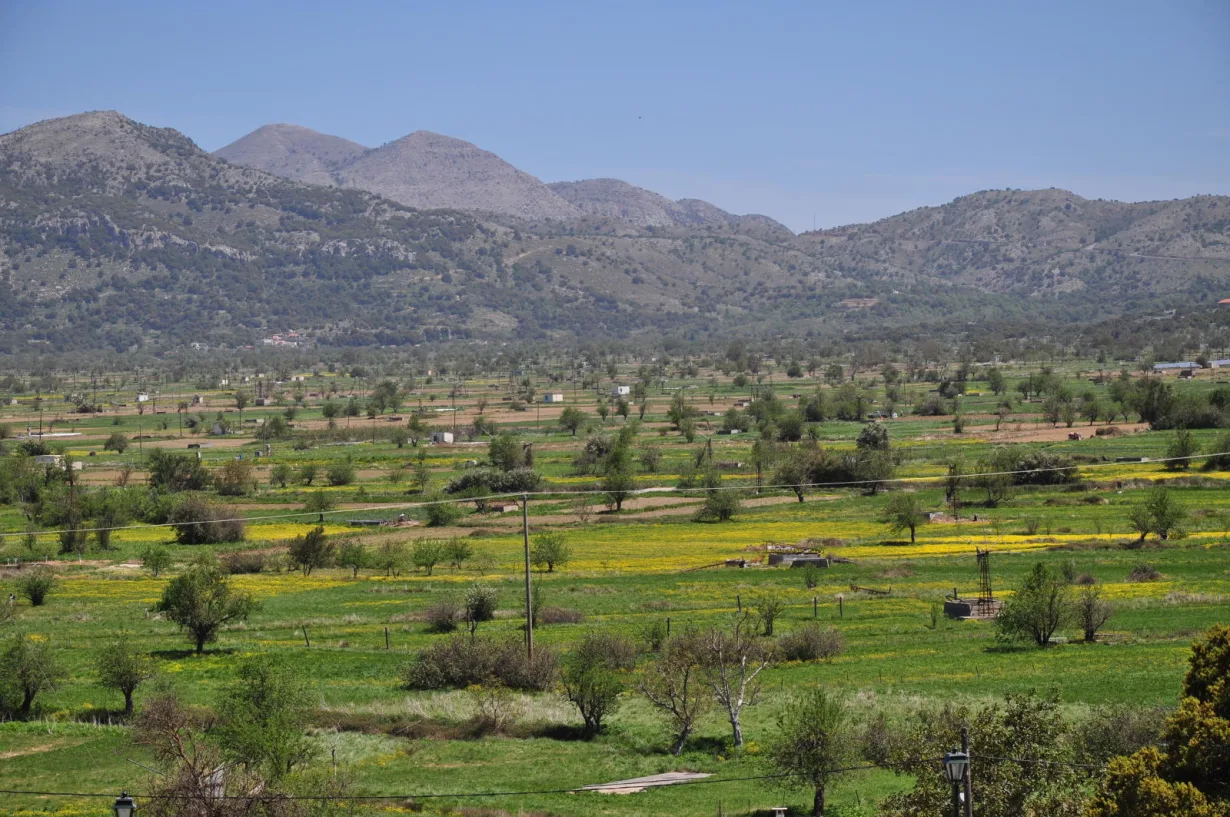
The stalactite cave where Zeus, the father of the gods, was raised by the goat Amaltheia is located near the Lassithi plateau in the Dikti Mountains.
The entrance to the cave is at 1025 m above sea level. Walkways lead down into the cave, which is illuminated by electric light, through a wonderland of stalagmites and stalactites. From the early Minoan period until late antiquity, i.e. from around 2500 BC to 400 AD, the cave served cultic purposes.
In and in front of it, archaeologists found small altars and numerous votive offerings. Most of them are now on display in the Ashmolean Museum in Oxford, UK. You will no longer see any cult objects in the cave itself. New finds are taken to the Archaeological Museum of Agios Nikolaos.
The Birth Cave of Zeus in Greek mythology
According to Greek mythology, Zeus was born in a cave on Crete by his mother Rhea, or at least brought there immediately as a newborn. His father Kronos had the unpleasant habit of devouring all his children as soon as they were born. Zeus was to escape this fate. Rhea deceived Kronos and handed him a stone wrapped in cloth as a substitute after the birth. She gave Zeus into the care of the goat Amaltheia, who nurtured and raised him in the cave. Nine demons, the Kouretes, beat their spears against their shields whenever the divine child cried out, so that the evil father Kronos would not hear the cries. As a youngster, little Zeus then left the cave and prepared to kill his father and take his place on the highest throne in the Greek heaven of the gods.
But as it is with myths: they are just scary and beautiful stories. That's why it's also possible that another cave in the Psiloritis Mountains near Anogia, the Ideon Andron, was considered the cave of Zeus in ancient times. There is also a compromise: Zeus was born on Psiloritis, but then raised here on the Lassithi plateau. It's up to you what you choose to believe!
Psychro and the Cave of Zeus: your visit
Psychro is the main destination of all tour buses on the Lassithi Plateau. A dead-end road takes you uphill, ending in a car park with several tavernas. Donkeys and mules await those who would like to ride, but you can also walk up in 15-20 minutes to the dripstone cave, Dikteon Andron, which is so closely connected to Greek mythology.
After about two years of renovation, the cave reopened on 29 May 2026. The steep stone path to the entrance has been rebuilt, the rock walls inside the cave have been secured and the lighting has been modernised. There is no lift: the way up is still a steep climb.
An excursion to the Lassithi Plateau in eastern Crete
Georgioupolis - Stalida - Mochos - Kardiotissa Monastery - Museum of Mankind - Ambelos Pass - Psychro Cave of Zeus - Avdou - Potamies - Chersonissos (approx. 320 km)
An early start is called for on this trip. You will be driving over 300 km after all. But there's no call for alarm: over two thirds of the route is on the well-developed National Road. You can usually make swift progress there.
Leave the National Road at Stalida, and then wind your way uphill on a well-made road with switchbacks. Far beneath you lie Crete's bustling mass tourist resorts of Limenas Chersonissou and Malia. Then you will reach the first small plain, where a great deal of wine is cultivated. You can finally enjoy a well-deserved coffee or herbal tea on the photogenic village square of Mochos with its many mulberry trees.
Mochos
The small village church stands right on the village square. There on the iconostasis hangs an icon with a motif that is rarely depicted: the Akathist Hymn. The Akathist is an early Christian hymn to the Holy Mother; it refers to the life of the Virgin Mary and praises her in ornate language. The hymn consists of 24 stanzas, each starting with a different letter down through the Greek-Byzantine alphabet. The icon is therefore divided into 24 image panels. Test yourself and try to correctly name all 24 letters!
The variety of images in the «O Skoteianos» kafenion is much easier to understand (and also to photograph). It is situated to the right of the main road, approximately 100 m from the Platia in the direction of Lassithi. The owner's son, a police officer serving on the mainland, has artistically painted the chairs and numerous wooden panels on the walls with portraits of Greek heroes, both legendary and historical. Like icons, they are inscribed, and anyone who can read a little Greek will quickly understand who or what is depicted.
Krasi
A little further on, a small detour leads you away from the most direct route and takes you into the tranquil village of Krasi, situated at 600 m above sea level. The plane trees growing here on the village square are held to be the oldest in Crete. A Venetian fountain brings water to the square. As you might imagine, Crete being Crete, a coffee house has set out tables and chairs underneath the trees. Incidentally, if you place the emphasis on the wrong syllable of «Krasi», the name of the village, it means «wine». So remember to place the emphasis on the first syllable!
Kardiotissa Monastery: Panagia i Kera
The Panagia Kera i Kardiotissa Monastery is well signposted on the main road, right before the village of Kera at 560 m above sea level. For years it has been tastefully restored with the aid of visitors' donations, and the inner courtyard has become a small garden paradise. The complex dates back to the 18th century, the church as early as the 14th century. A small column in the courtyard, the highly venerated Marian icon and a piece of iron chain are the subject of a richly embellished legend about the icon that returned to Kera from Istanbul three times.
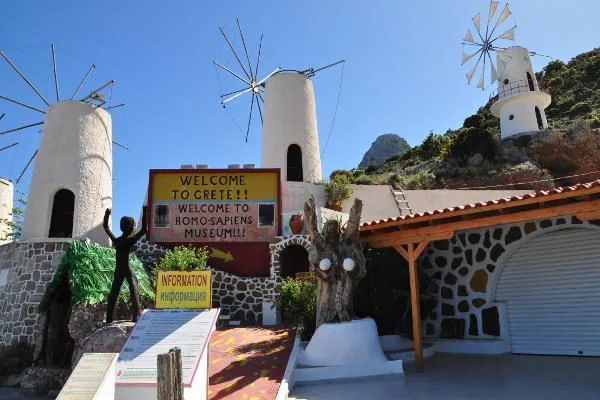
From Kera, the road rises sharply up to a mountain pass, which you can recognise from afar thanks to the bases of its many stone windmills. On this road, one Cretan realised his lifelong dream of creating his own private «Museum of Mankind». Everything you see here was conceived and financed personally by this former customs official, who built and developed the museum with his own two hands over many years. When Giorgos has time, and he usually does, he's happy to personally guide visitors through his imaginative kingdom.
Museum of Mankind
For Giórgos Petrákis, the first man on the moon was the main event in his life. He was only 16 years old in 1969, when Neil Armstrong first set foot on the Earth's natural satellite, on the 21st of July at 4:56 am, Greek time. His grandfather woke him up especially, so that he could follow events on their black and white TV screen. At that moment, it was suddenly clear to Giórgos: «This isn't one individual conquering space for himself. All of us, together, are making this giant leap in the history of mankind.» The pursuit of human history became his hobby.
To enter his open-air museum, you pass through a labyrinthine passageway. Statues of a Neanderthal and the cosmonaut Yuri Gagarin are placed at the beginning. At the end, a petrified tree trunk from the island of Lesbos is on display; it is 180 million years old. Then the depiction of the different stages of human development begins, from cave men in the Palaeolithic Age, all the way to the development of settlements and the creation of the Greek pantheon. All twelve Olympians are present as statues. With this, Giórgos considers the first stage of human development complete. A particular indicator of our further development is the increasing average life expectancy from era to era: it is stated for each epoch on information panels, which are always kept very short. Now you are standing in front of a small chapel, which Giórgos took about five months to build. «And then came Jesus Christ», states a panel in six languages.
Opposite, a small special exhibition shows the development of the wheel, which Giórgos sees as culminating in the introduction of the light alloy wheel. He has nothing to report from the next 2000 years or so, until the day when Yuri Gagarin completed the first human space flight in 1961. For Giórgos, this is when the third stage of human history was achieved: «From Homo erectus via Homo sapiens to Homo cosmicus», as he puts it. Giórgos has intensely devoted himself to the expansion of his space travel section. He commemorates Laika, the dog who was the very first living creature to be catapulted into space in 1957, and on the suggestion of a Russian tourist he even established a memorial to Valentina Tereshkova, who was the first woman in space in 1963. For Giórgos, the culmination is a memorial which he considers to be one of a kind. It cites five accidents and lists the names of 21 men and women. On the commemorative plaque he describes them as «Space Heroes». When Giórgos reads their names aloud, he is often moved to tears, and he loves to tell of the many Russians who have expressed their gratitude to him that a Cretan is commemorating their dead from the Soviet period.
It's easy to fall into conversation with Giórgos at the museum's café-bar. When you talk to him, you usually discover what fascinates him most about the development of mankind: «Man has no wings, no fur, and no fangs. He only has his brain, his hands and his vision. And with these, and nothing more, he has gone so far as to conquer space.» And by these same means, Giórgos has gone so far as to create his own museum. Since 2016, it has also included a horse, which naturally played a crucial role in human history. It is life size, but made of granite. If you want, you can swing yourself onto its back and have a photograph taken with a lance in your hand, in the style of Alexander the Great.
Ambelos Mountain Pass
A long line of old stone windmills stands on this 900 m high mountain pass, Seli Ambelou, in the south of the Lassithi Plateau, most of them sadly just ruins. Grain was milled here right into the post-war period. Today, you will find a large taverna here with a panoramic terrace, from which you have the whole plateau before you. They serve delicious roast pork from the wood-fired oven, which stands to the left of the entrance to the taverna and gives off a heavenly aroma. Potatoes from the Lassithi plain are served with your meat.
More about the Lassithi Plateau
The plain is on average 840 m above sea level, 8-10 km long and up to 5 km wide. The peaks of the Dikti Mountains (Dikti Ori), reaching up to 2148 m, shield it from the outside world. The plain consists of fertile alluvial land, which is partially under water in winter. The masses of water from rain and melted snow flow away underground in the north-west of the plain, next to the village of Kato Metochi, and bestow the farmers up here with more than enough ground water all year round, lying 15-25 m below the surface.
These days, it is pumped up to the surface to water the fields using motor pumps from about the middle of June. Old postcards and photos, as well as reconstructed windmills, which are mostly situated close to tavernas, show what made this plateau unique in the past: it resembled an ocean of windmills set with canvas sails. Farmers mostly plant and harvest potatoes and apples here, but they grow other kinds of fruit and vegetables as well. Organic potatoes are becoming popular, because they fetch a higher price. The farmhouses are spread across a total of 21 villages, almost all of which are settled along the edge of the plain, so that none of the precious farmland is wasted.
Vidiani Monastery
It takes less than two minutes to drive down from the mountain pass to the plain. Down here, it's best to turn right and make the circuit of the plain anti-clockwise. Straightaway on your right, you'll see the small Vidiani Monastery, which has been elaborately restored. The monastery has a tiny natural history museum, which is really only of interest to school groups. Continue through tiny villages along the edge of this fertile plain until you reach Psychro and the Cave of Zeus.
Agios Georgios
You can take a peaceful break in the largest village on the plateau, but you can also visit two small village museums, set side by side. The Folklore Museum in an old farmhouse vividly depicts how people lived here right into the post-war period. You can also pick up the key there for the Venizelos Museum, diagonally opposite. Some historical photos and documents here inform visitors about the life of the great Cretan statesman Eleftherios Venizelos and the writer Nikos Kazantzakis.
Back via Chersonissos
Lastly, leave the plateau behind via the Ambelos mountain pass. After Kera, follow the road that takes you through the villages of Gonies, Avdou and Potamies, down to the coastal plain. Before re-joining the National Road to Georgioupolis, you can take another pleasant break in a taverna on the beautifully designed village square of the inland village of Chersonissos.
You are in category:
You might also be interested in:
Experience Crete Your itinerary contains 1 experience
gorgeous
beaches romantic
old towns picturesque
places fascinating
ancient sites imposing
gorges unique
nature delightful
boat trips rewarding
excursions extraordinary
stalactite caves adventure
& thrills secluded
monasteries gourmet
restaurants culinary
products