Fascinating ancient sites
Argyroupolis and the ancient city of Lappa

The idyllic mountain village of Argyroupolis is located at the north-eastern foot of the White Mountains on the territory of the ancient city of Lappa. There you will find numerous rock tombs dating from the 300 years between about 100 BC and 200 AD, part of a much larger cemetery of the ancient city of Lappa.
You can happily spend a whole day in Argyroupolis. Here you can shop for ecological products, dine on wonderfully fresh trout and, above all, feel at first hand that many a Cretan village of today was a much more important town in antiquity and the Middle Ages. In a valley densely covered with trees, ten powerful springs rise, some of which supply the city of Rethymno with drinking water. Today the village has only a few hundred inhabitants; 2000 years ago there were about ten thousand. The name of the village means «Silver City», but no one really knows why.
Just outside the beautiful mountain village, on the road towards Kato Poros, you will see a brown signpost reading «Church of Holy 5 Virgins / Cemetery of Ancient Lappa». Leave your car here and follow the sign on foot along the good path that runs past lemon and orange trees. After only 100 m you will discover the first ancient tomb on the left in the low rock face. After another 150 m, you will reach the small chapel of the 5 Holy Virgins. In its forecourt and in the rock face behind the church you can see numerous other rock tombs and also go inside.
On the way to the historic village centre
We recommend that you first drive right into the village centre, with the village church built in 1895 and its filigree bell tower. You will easily find a parking space there. Opposite the church you will see an arched gateway: the main entrance to the historic village centre.
The shop «Lappa Avocado» occupies both sides of the arched gateway. In 1984 a farming family started to grow the exotic fruit here and planted the first 500 trees. Since the foreign fruit sold only slowly in Greece, in 1996 the family came up with the idea of making avocado oil and developing cosmetics from it, especially for problem and very sensitive skin. Their success has continued to this day, and they now have over 2500 trees. The small kafenia opposite the arched gateway have other ideas for using the avocados: they serve them with creamed tuna, scampi or honey and yoghurt, use them in salads and press them into avocado juice.
In the avocado shop and the kafenia you can also get a small map of the historic village centre free of charge. It leads you to various sights, which you can visit on a walk of about 20 minutes.
Agia Paraskevi church, sarcophagus, ancient columns
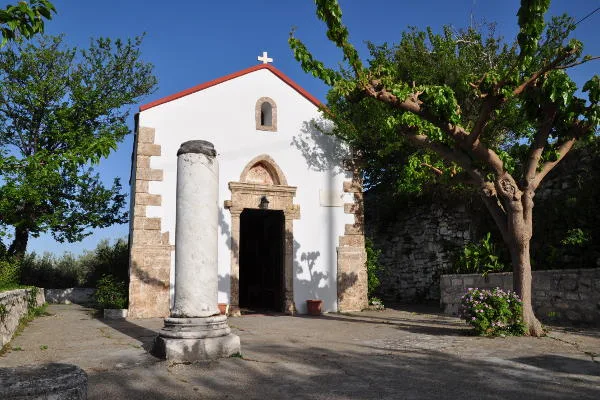
Two of these sights are particularly worthwhile. Firstly, the small Agia Paraskevi church down to your right at the end of the straight main street. As you descend the steps from the street to the churchyard, be careful where you tread: one of the steps is the lid of an ancient child's sarcophagus, a marble child's coffin. Incidentally, the word «sarcophagus» means «flesh eater». An ancient column taller than a man still stands in the churchyard, and the remains of other columns lie around it. They come from the ancient city of Lappa, the settlement that preceded Argyroupolis. It was founded around 2800 years ago and was one of the most important cities on Crete, especially in Hellenistic and Roman times.
In the small church you will see several icons of Saint Paraskevi. She carries a pair of eyes on a small dish. The saint is an early Christian martyr from Cyprus, whose eyes were put out because of her faith. Today she is considered the patron saint of people with eye ailments. Numerous shining silver votive plaques with a pair of eyes show that believers with eye problems still turn to her today.
Roman floor mosaic
The second main sight in the historic village centre is the remains of a colourful Roman floor mosaic. Go up the lane straight to the left of the avocado shop, and you will be there in two minutes. It may only show geometric patterns, but it testifies to the wealth and way of life of the city's inhabitants around 1900 years ago.
Springs, water mills and romantic tavernas
After this walk you might be feeling hungry. Drive back towards the north coast and turn left downhill before you reach the end of the village. After a minute you will arrive at several tavernas in the wooded valley with the springs. Several water mills used to stand here. You can still see the remains of one of these mills in the «Palios Mylos/Au Vieux Moulin» taverna. All of the tavernas here serve trout bred in the spring water, and some also serve sturgeon. Those who don't like fish will also find lamb's liver and meatballs on the menu, for example. Spring water is always served free of charge.
After this refreshing break, drive back to the village and turn left onto the road leading to the north coast. You will soon pass the large, modern «Creta Carob Store». A member of the family that grows the avocados started to use the carob trees, which grow in great numbers on Crete, commercially again. You can now buy products made from the long, brown pods of this tree here: substitutes for coffee, cocoa and tea, honey, syrup, flour, rusks, biscuits, pasta. You will be amazed at all the things you can make from carob!
The cemetery of the ancient city of Lappa
Straight after the shop, a road branches off down to the right towards Kato Poros. After 400 m you will see the brown sign on the left to the cemetery of Lappa and the chapel of the 5 Holy Virgins described above. In the gorge below the chapel you can walk on for a few more kilometres.
You are in category:
You might also be interested in:
gorgeous
beaches romantic
old towns picturesque
places fascinating
ancient sites cretan
culture imposing
gorges unique
nature delightful
boat trips rewarding
excursions extraordinary
stalactite caves adventure
& thrills secluded
monasteries gourmet
restaurants culinary
products