Imposing gorges
The Samaria Gorge and Agia Roumeli


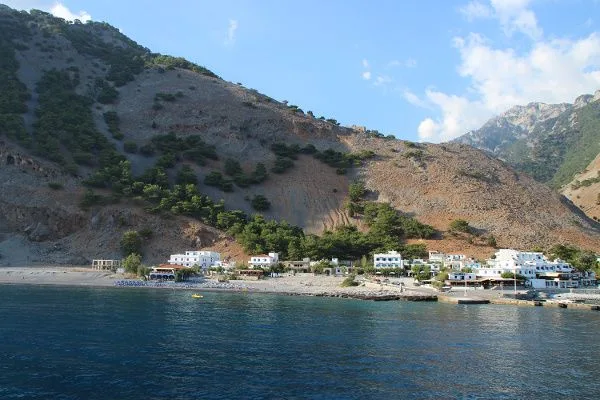
One of the main attractions in the picturesque nature of Crete is the Samaria Gorge, sometimes called the «Grand Canyon of Europe». One of the longest trekking gorges on the continent, it is truly exceptional and captivates many hikers.
The gorge is part of the European E4 trail and has a length of 16 kilometres. It stretches along the majestic Omalos plateau west of the imposing White Mountains to the blue Libyan Sea. Right at the exit of the gorge is Agia Roumeli, a charming harbour town.
Many smaller side gorges branch off the Samaria Gorge, and they can only be walked with extensive equipment. You do not need any special hiking equipment for the Samaria Gorge itself, but you should wear sturdy shoes to explore this top sight safely and comfortably.
The official length of the gorge of 16 kilometres refers to the walking distance from the settlement of Omalos north of the plateau to the village of Agia Roumeli. You enter the gorge at the northern entrance, which lies at an altitude of about 1,230 metres. From there you head south to the shores of the Libyan Sea in Agia Roumeli. A hike of about 13 kilometres through the Samaria National Park awaits you, and another three kilometres take you from the park exit to Agia Roumeli. So your total hiking route is 16 kilometres.
How much time you need depends, of course, on your own pace. You should allow between four and seven hours, which is why you should plan a day trip to visit the Samaria Gorge. Some holidaymakers even come to Crete just for the impressive gorge.
The Samaria Gorge: spectacular, but not tame
The Samaria National Park is the most popular hiking destination on the island. Given its length and the initial precipitous drop (600 m descent in 2 km), the gorge is conventionally walked in one direction, from Omalos down to Agia Roumeli. Moreover, as there is no road connecting the two villages, hikers find it most convenient to book a tour with external operators, who will pick you up from your accommodation and ensure your return journey.
The initial descent involves a precipitous downhill hike through pine forests. Good footwear and walking sticks to protect your knees are a must. The entrance fee is invested in maintaining the trail, and there are toilets and fresh spring water at the rest areas along the way, so you only need to carry one bottle that you can refill. Bring something to eat, though: there is nothing to buy inside the gorge.
Agia Roumeli
Most visitors to Agia Roumeli arrive with a deep sense of gratitude and an air of light exhaustion. That is because most of them will have arrived in the small seaside village after a 16 km hike down from 1,230 m above sea level through the breathtaking Samaria Gorge.
Agia Roumeli is the village at the end of the Samaria National Park, and home to the ferry terminal that transports day-hikers to Chora Sfakion or Sougia, where the buses wait to take them home. But visitors who come with time on their hands for this peaceful community will find that Agia Roumeli is so much more than just the end of the road.
A hiker's paradise
Agia Roumeli is not just the end of the road; it sits slap bang in the middle of it, straddling what is without doubt the most stunning coastal hiking route in all of Crete. To the west, the E4 European trail between Sougia and Agia Roumeli is the most mountainous and challenging section of the route, but rewards hikers with stunning views from atop coastal cliffs, and with the utterly secluded beach of Domata, a steep and dizzying four-hour hike from the village. To the east, more leisurely walkers can enjoy the easy, well-defined trail towards Loutro, with the ancient Byzantine chapel of Agios Pavlos at the spot where St. Paul is said to have landed on Crete, and the small but beautiful beach of Marmara, offering stunning sea caves with sparkling, translucent water.
The western route is only to be attempted by experienced hikers, with proper equipment, plenty of water, and a buddy. The eastern route is an enjoyable day hike that can be attempted by most. The full walk from Agia Roumeli to Loutro takes around 7 hours, but the ferry stops at both villages, either returning visitors to Agia Roumeli, or taking them on to Chora Sfakion, where you are reconnected to the road network.
Hidden treasures
The village of Agia Roumeli is very small. Two main parallel streets connect the tavernas on the waterfront with the small souvenir shops and restaurants tucked in behind. Further back is living evidence of the fresh, organic, free-range produce that they prepare. Herds of goats and flocks of sheep and chickens roam freely beneath fruit-bearing trees and next to fenced-off crops: a rural idyll that continues in the background behind the busy tourist port.
Even if you are not attempting the hike through the Samaria Gorge, a walk to its exit is well worth it. It takes you approximately 3 km along a paved road wide enough for the buses that go to collect the weary walkers, and is therefore suitable for families with small children. In the spring, the valley is flushed pink with oleander bushes and a sparkling clear brook gushes under a series of bridges that criss-cross its path.
The road winds its way between the old stone walls of the former village of Agia Roumeli, which appears much larger than the small seaside hamlet of today. It was largely abandoned in the 1950s, when flood waters ruined many of the houses. Today, it is mostly inhabited by goat herds, fenced in between the ruined houses, a testament to times gone by.
The Samaria Gorge Lite
For those who wish to enjoy the beauty of the Samaria Gorge without the physical challenge, Agia Roumeli offers an easily accessible doorway. Visitors from Georgioupolis can drive down to take the morning ferry from Chora Sfakion or Sougia, and walk the easy, flat 3 km from Agia Roumeli village to the «exit» of the gorge along the paved road. Entry is also permitted from this side, with the same ticket, and in less than 4 km you can witness the gorge at its most beautiful: its Jurassic rock-face rippling like water in a pool; the narrow, towering sides rearing up over 100 m high and just 3 m wide at its narrowest point, known as «Portes»; the fathomless tenacity of flowering trees and shrubs clinging to its bare rock walls, and the series of picturesque bridges criss-crossing its river bed.
The gorge is best visited in spring and early summer, from its opening in May to the beginning of June, when the plants are in bloom, water still runs in the brook, and the midday sun has not climbed to its summer temperatures.
Season, tickets and rules
The gorge is usually open to hikers from early May to the end of October. After heavy rain, in storms or when there is a risk of rockfall, it is closed for a day or longer; in 2026, for example, it only opened on 19 May because of damage from the winter. So check the day before whether the gorge is open.
The entrances at Xyloskalo (Omalos) and Agia Roumeli open at 7 am. Staying overnight in the national park is not allowed, so all hikers must have left by evening; if you arrive late, you may only walk part of the way. Your ticket is checked at the exit, so that the rangers know everyone has left the gorge safely. Keep it until the end.
The entrance fee is 10 euros (2026), or 8 euros per person in groups of ten or more. Children and teenagers and people over 65 enter free. You can buy the ticket at the entrances or in advance online from the national park authority. Free safety helmets are available at both entrances; wearing one is optional but strongly recommended.
In the national park, camping or staying overnight, fires, alcohol, swimming in the stream and leaving the path are prohibited. Smoking is only allowed at the rest areas, and dogs must be kept on a lead.
You are in category:
You might also be interested in:
gorgeous
beaches romantic
old towns picturesque
places fascinating
ancient sites imposing
gorges unique
nature delightful
boat trips rewarding
excursions extraordinary
stalactite caves adventure
& thrills secluded
monasteries gourmet
restaurants culinary
products