Picturesque places
Agia, Meskla and Therisso: a round trip below the White Mountains

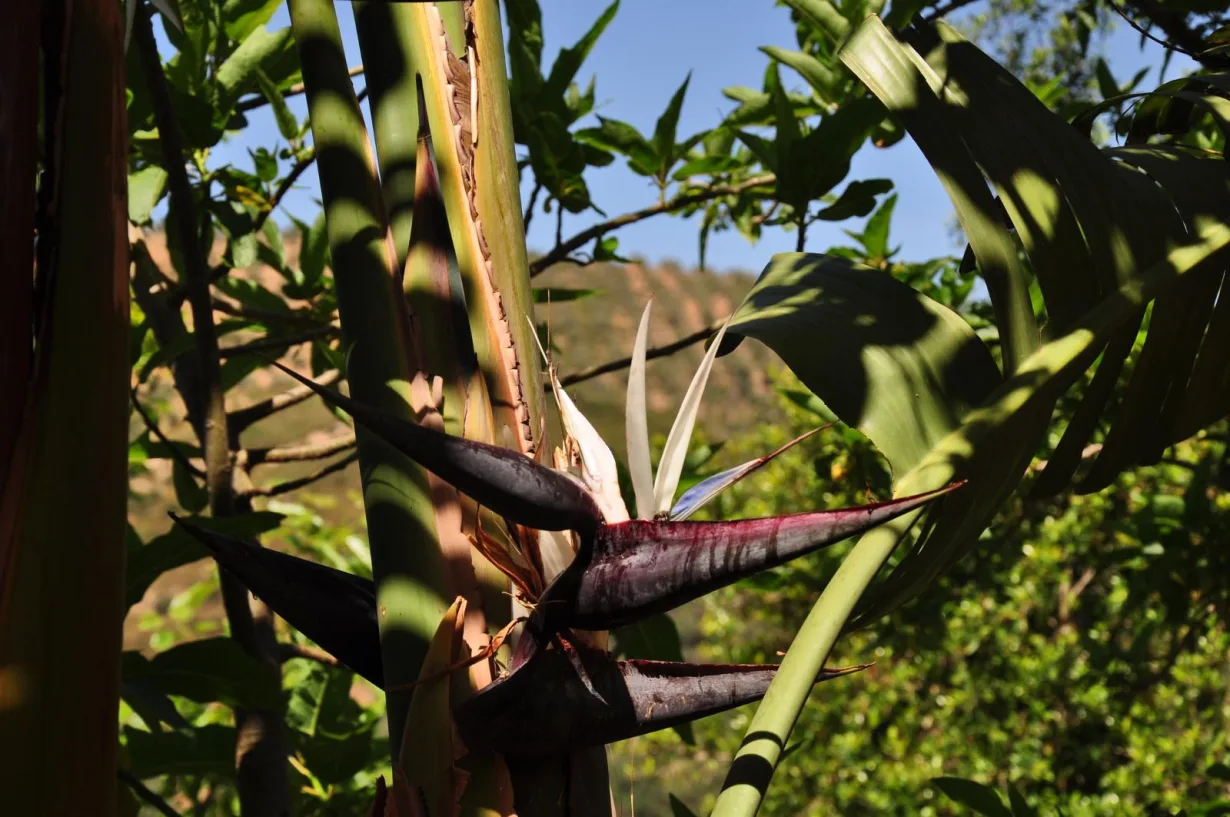
This tour is an absolute must for nature lovers. It takes you to Lake Agia, a bird paradise all year round. You will cross Crete's 'Orange Valley', with thousands of orange trees, and visit the largest botanical garden on the island, where the restaurant will delight passionate vegetarians in particular. You will experience a wonderfully beautiful gorge from the comfort of your car, and stop on the way in a mountain village that is of particular importance in recent Cretan history.
From Georgioupolis, the National Road takes you past Aptera and Chania to an exit signposted 'Omalos' and/or 'Sougia'. Of all the things to drive past, in the village of Oassis you will see the prison of western Crete on the left-hand side, a large white building with extensive flower beds along the street. Just after that, a large green sign marks the 'Lake Café' to the right of the road. Follow the sign to Lake Agia.
Georgioupolis - Agia - Botanical Park of Crete - Meskla - Therisso (approx. 140 km)
Lake Agia
Lake Agia is much smaller than Lake Kournas and lies in flat surroundings, but it is beautiful in its own right. Unlike Lake Kournas, it is not a natural lake: until 1927 there was a swamp here, fed by karst springs from the White Mountains, and in 1928 a small hydroelectric plant went into operation. Its shores are lined by a thick belt of reeds, and a path takes you around the lake in about an hour. In dry summers the water level drops sharply, most recently in the summer of 2025.
From the Lake Café, you can take a well-maintained path along the shore to the little wood opposite, beside which Agios Konstantinos church looks almost Tuscan with its red tiled roof, small bell tower and arched windows. The café is particularly well suited to families with children, offering a lovely lawn and even a small football pitch. The terrace is a wonderful place to watch herons, ducks and geese, while numerous songbirds flit past overhead.
The 'Orange Valley' of Crete
At the Lake Café you will already drive past the first large orange plantations. You are now entering the Orange Valley of Crete. The villages here are also known as Portokalochoria, or orange villages. Follow the Greek sign to 'Agyia' to get back onto the main road, and follow it towards Omalos. The Botanical Park is already signposted here. Before you get there, you will pass through the village of Fournes, with two packing stations for the orange harvest. Oranges have brought the farmers little joy for years, because producer prices are often very low. However, they continue to grow them, and in Fournes you will even see them between all the houses of the village. The main harvest takes place between December and April; there is a second harvest for another variety of orange in May and June.
Botanical Park & Gardens of Crete
High above Fournes, the Botanical Park of Crete awaits you to the right of the road to Omalos, barely 60 km from Georgioupolis. This is where Crete's first botanical park has grown, above the Orange Valley. On 20 hectares, around 150 different kinds of fruit trees from all over the world flourish, along with herbs and medicinal plants, flowers and blossoming shrubs. Plants from three different climate zones thrive here, including many tropical as well as Cretan blooms. Signs in Greek, English and Latin give their names. A 2 km circuit and 1 km of side trails guide you through the park. It is open daily from 9 am, from late March to late November, and admission is €8.
The Botanical Park is a private endeavour. It belongs to a family from the nearby village of Skordalou. Until October 2004, almost 60,000 olive trees grew here. Then an electricity pylon fell during a southerly storm and started a fire that destroyed all of the trees within 24 hours. One of the family's four sons had the idea of turning the burned land into a park. His three brothers and his parents were happy to join in. Crete's blessed climate ensured that the idea quickly became reality.
You should plan at least two hours for the circuit of the park, where ducks, geese, peacocks, farm animals and numerous wild animals also live. Afterwards, the unusual park restaurant awaits you. Here they use almost exclusively produce from the park, so there is no apple or pear juice, because these fruits don't grow in the park. Instead, guests are served seasonal juices made from freshly harvested Mediterranean and tropical fruits. Cretan dishes get a special touch from limes and lemongrass grown in the park, and the homemade lemonade is refined with mint. Bread comes from their own wood-fired oven, and the meat for the few non-vegetarian dishes comes from livestock farmers in the surrounding area.
If you don't mind driving back to Georgioupolis in the dark, you can experience a Cretan evening here on Mondays in summer. After a buffet of produce from the garden, guests head down to the small amphitheatre in the park for Cretan folk dances, accompanied by musicians playing the lyra and the laouto.
The mountain villages of Meskla and Therisso
After the Botanical Park, drive back to Fournes and turn right towards Meskla, which you reach after 5 km through a lush, green river valley. The village itself isn't anything to write home about, but it impresses with its wonderful location. That's why people have started to replace the trees on the hillsides here with villas.
Shortly after entering the village, a brown sign points to the 'Church of Christ Savior' 50 m away. Its doors are usually open. In the narthex, or vestibule, you can make out the remains of a depiction of the Last Judgement; in the first niche on the right inside the church there's a fairly complete Metamorphosis, the Transfiguration of Christ on Mount Tabor (both wall paintings date from the 14th century). Much more impressive, however, is the church of the Virgin Mary on the way out of the village. It is large, but looks as delicate as a toy, and was built right onto an old church of the Virgin from the 14th century (both open only now and then). A powerful spring gushes forth here, which naturally has its own taverna.
After Meskla, the road rises sharply, passes two panoramic tavernas and reaches the village of Zourva, 570 m above sea level. An excellent tarmac road takes you on past slopes full of oleander, until 7 km after Zourva the road reaches Therisso. Here, you can spend half an hour following in the footsteps of recent Cretan history.
Therisso
This small mountain village is something like the birthplace of modern Crete, and alongside Arkadi Monastery it is the second 'national sanctuary' of the island. In 1898 the Cretans had finally thrown off the yoke of Turkish rule. However, the Great Powers of Britain, France, Russia and Italy didn't want to allow the island's union with Greece, which was already free, right away. They declared Crete an autonomous state whose nominal head remained the Turkish sultan. As High Commissioner, they installed the Greek Prince George, after whom our village of Georgioupolis was named. George proved to be weak, however, and bowed again and again to the interests of the Great Powers, which kept powerful consulates in Chania.
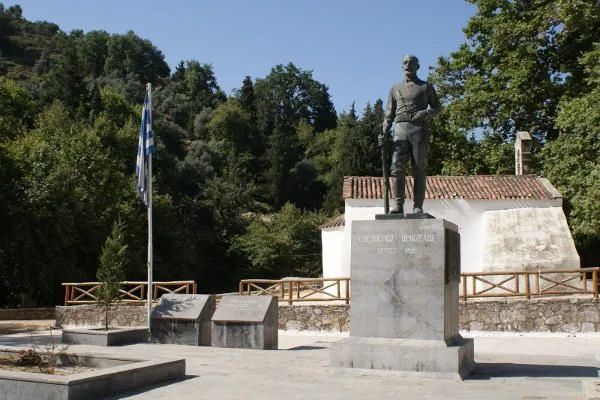
That's why the Cretan politician Eleftherios Venizelos, who was born in the nearby village of Mournies in 1864, called for a rebellion. Under his leadership, the declaration of revolution was drawn up in Therisso in 1905, calling for resistance against the arbitrary rule of the Great Powers and the prince they had appointed. The rebellion, led from Therisso, brought about the prince's resignation in 1906. Even so, it took another eight years for Crete to be united with Greece. That only happened in 1913. Eleftherios Venizelos experienced it as Greek Prime Minister, an office he first took in 1910 and held several times until 1920. After years of exile in Paris, he governed the country again from 1928 to 1933. He died in Paris in 1936.
In the village centre, the house that served as the headquarters of Venizelos and his rebels in 1905 is now a museum, showing photographs, documents and weapons from the years of the revolution, among them the flag inscribed 'Therisso 1905'. It was modernised in 2019. Admission is free, and opening hours change with the season. A second museum diagonally opposite commemorates Cretan resistance to the German troops in the Second World War.
Of course, there is also a monument to Eleftherios Venizelos on the village square, in front of the small, very plain double church of Agia Ekaterini and Panagia. Indeed, the ten (yes, ten) tavernas right on the main square are much better frequented than the church. They live from Cretan school trips and locals out for a Sunday drive.
Back to Georgioupolis
Shortly after leaving Therisso, the Therissiano Gorge begins. It is about 6 km long and winding. During the Ottoman occupation, several battles were fought here between Cretan freedom fighters and the Sultan's troops. Even confirmed drivers can enjoy the thrill of a Cretan gorge here at their leisure.
The road then leads through Mournies, with the birthplace of Eleftherios Venizelos, and reaches the National Road, taking you back to Georgioupolis.
You are in category:
You might also be interested in:
gorgeous
beaches romantic
old towns picturesque
places fascinating
ancient sites imposing
gorges unique
nature delightful
boat trips rewarding
excursions extraordinary
stalactite caves adventure
& thrills secluded
monasteries gourmet
restaurants culinary
products