Picturesque places
Sfakia: Chora Sfakion, Loutro and the Aradena Gorge

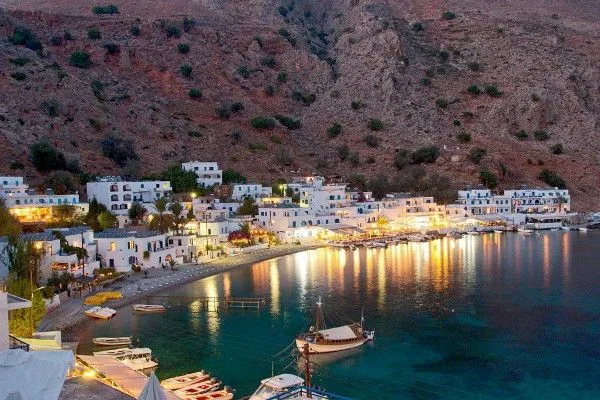
Chora Sfakion may only have around 320 inhabitants, but it is proud to call itself the 'Capital of Sfakia', a region considered one of the wildest and most remote on the whole island. Its people took part in practically every rebellion against the Turks, and vendettas remained an unwritten law here well into the post-war period.
The most famous Sfakiot is the rebel leader Daskalogiannis (meaning 'Ioannis the Teacher'), who was captured by the Ottomans in 1771 and skinned alive in Heraklion. Today, many streets and squares throughout Crete are named after him. During the Second World War, the Sfakiots took to the hills to fight the German occupying forces. They fought to protect the retreating Commonwealth troops, the last of whom were evacuated from Chora Sfakion on the night of 31 May to 1 June 1941. Standing at the port of Chora Sfakion, gazing out across the Libyan Sea, you can picture the boats that carried the last of the Allied troops to North Africa.
Chora Sfakion, Crete
These days, Chora Sfakion is a peaceful place. The only signs of violence are the bullet holes in the road signs on the twisting route down the mountains. They serve as target practice for the locals, who often still keep a gun, mostly only to fire into the air at weddings, christenings and other celebrations. Visitors who make it this far south will be greeted with the same warm hospitality as in the rest of the island. Most are hikers coming from the E4 European long-distance path or returning from the Samaria Gorge.
Driving the road down to Chora Sfakion is an adventure in its own right. From the Askifou Plateau and the entrance to the Imbros Gorge, 20 narrow, tight switchbacks lead down to the shore. On a map, the road looks rather like a coiled spring. The historic village centre is clustered around the small harbour with a waterfront promenade about 100 m long, where tiny tavernas jostle for space.
A second street runs behind the promenade with a few shops, and that's it. There's not much more to see in Chora Sfakion. There's no lack of parking spaces, though, as most visitors are here to take a boat from the new harbour. From here, ferries sail to Loutro and to Agia Roumeli at the exit of the Samaria Gorge, and to the island of Gavdos. Via Agia Roumeli you can continue to Sougia and Paleochora.
In between the comings and goings of ferry passengers, Chora Sfakion is a tranquil retreat and a good place for a swim. The only beach in the village is Vrisi Beach, with fine gravel and about 70 m long. About 1.5 km out of town, the road takes you to Ilingas Beach, which has a section for naturists.
Aradena Gorge
To make Chora Sfakion more than just the start or end of your ferry ride, a 10 km detour into the mountains is very much worth your while. Follow the road north-west out of town up to the village of Anopoli, 600 m above sea level. You will be rewarded with a picture-perfect rural idyll. Anopoli also offers a unique activity for thrill-seekers: at weekends from June to September, the narrow single-lane bridge across the Aradena Gorge becomes the venue for one of the most extreme bungee jumps in Europe. At 138 m, it is the highest in Greece and one of the highest in Europe. The natural surroundings are spectacular, if you can focus on anything other than the adrenaline rush, that is!
Don't be alarmed by the vultures that occasionally circle the gorge. Bungee jumpers are not their main food source, we promise! For more information, visit the operator Liquid Bungy.
Loutro: On Foot or By Sea
These days, Loutro is one of the few villages on Crete that can only be reached on foot or by water. Ferries and water taxis link Loutro with Chora Sfakion. Those who choose to walk can take the E4 European long-distance path west from Chora Sfakion. This section is approximately 6 km long and takes about 2 hours. It is a scenic coastal stretch passing a picturesque castle and a shrine, with only one small difficult section where you cross scree on a rocky slope. The path is open all year round, although people only live in Loutro in the summer.
Thanks to the energy and investment of a certain English hotel owner and her Cretan husband, the hamlet of Loutro is thriving. This entrepreneurial lady has paid great attention to the appearance of the village, making sure that all buildings old and new keep the traditional look of white-washed walls with blue doors and window shutters. She has also made certain that Loutro keeps a family-friendly atmosphere. There is no loud music after 10 pm, and topless or nude bathing is not allowed in front of the promenade.
The pebble beach of Glyka Nera lies to the east, around the corner from the small cape of Pounta with its picturesque chapel. There is a lovely beach bar here, which you can reach on foot along the E4 or by boat. In the other direction, to the west, it's about a 30-minute walk along a rocky trail to the ruins of a medieval fortress and on to Finikas Bay, with a small gravel beach and the remains of ancient cisterns.
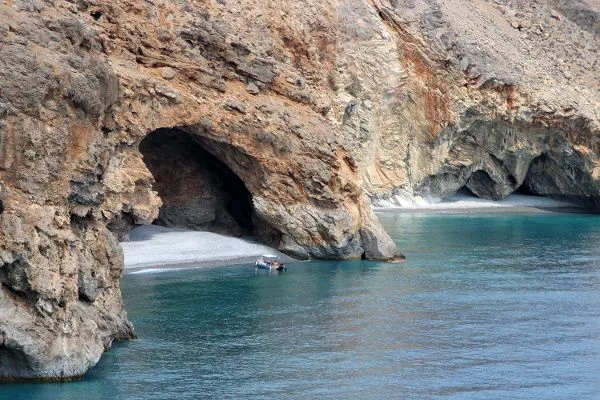
In summer, guided sea kayak tours set off near Chora Sfakion and take you along the coast past Glyka Nera (Sweet Water Beach) as far as Loutro, exploring the sea caves and beaches along the way.
You are in category:
You might also be interested in:
gorgeous
beaches romantic
old towns picturesque
places fascinating
ancient sites imposing
gorges unique
nature delightful
boat trips rewarding
excursions extraordinary
stalactite caves adventure
& thrills secluded
monasteries gourmet
restaurants culinary
products