Picturesque places
Agios Nikolaos and Elounda: sights, Spinalonga and Kritsa

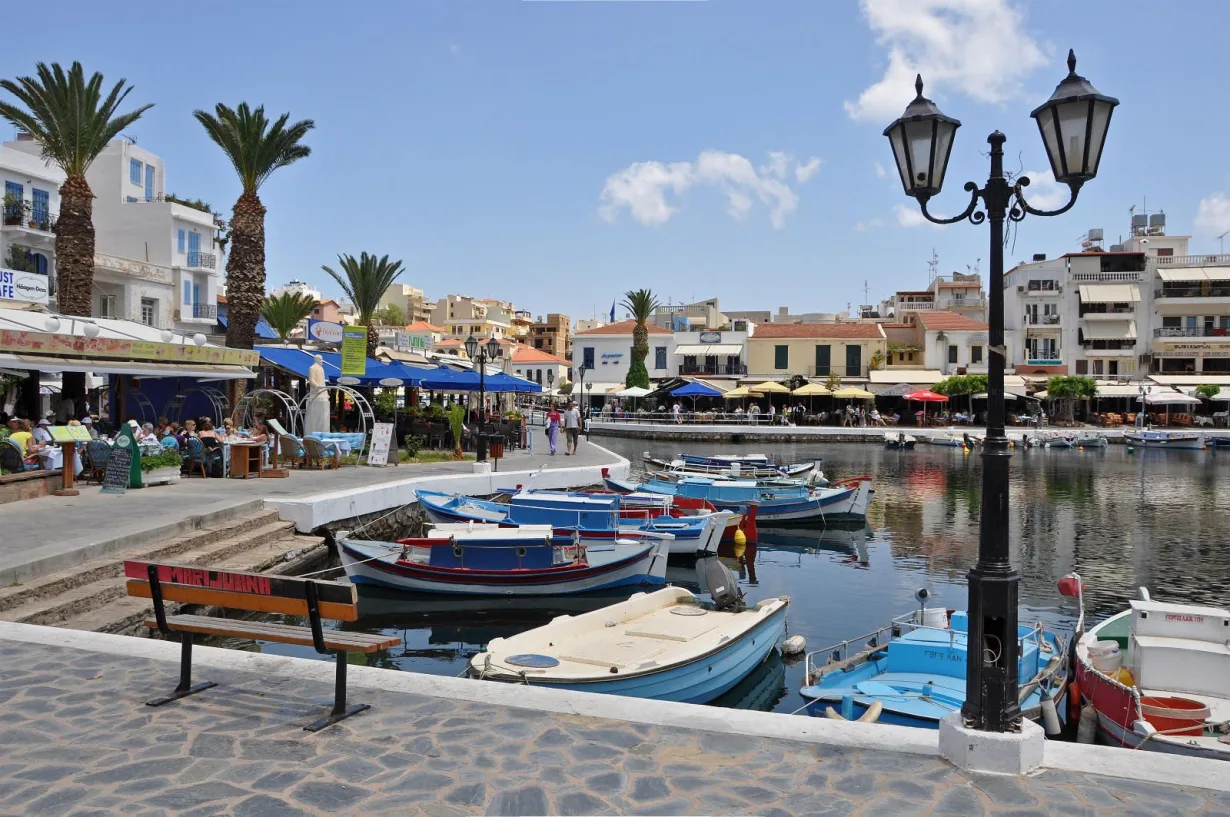
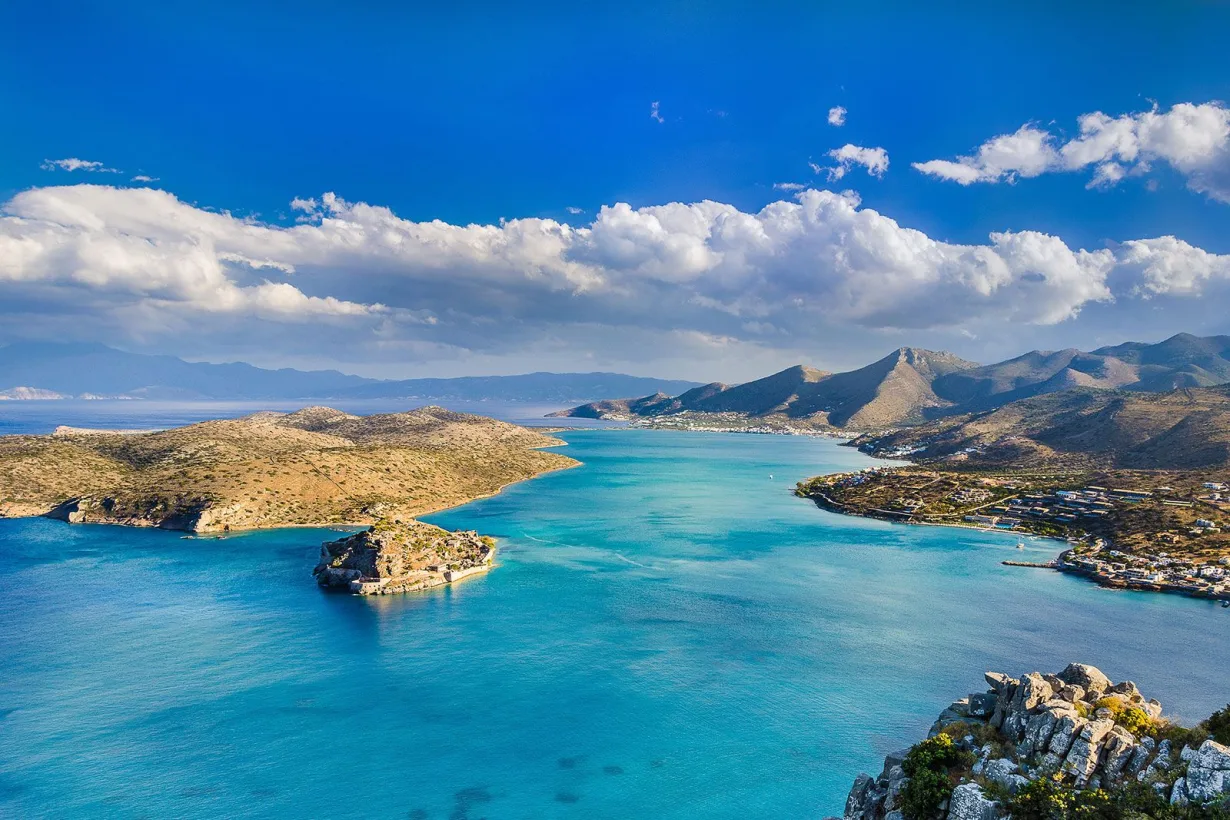
Agios Nikolaos is a peaceful little town on a range of hills. The coastline is long with many contours, and a small inner lake connected to the sea serves as a harbour for fishing boats.
The development of Crete as a holiday island began in Agios Nikolaos around 1960. The fast-paced and humorous book "Winds of Crete" tells the tale very nicely (incidentally, the second part takes place in Georgioupolis). Fifteen minutes along the coast, the former fishing village of Elounda has become a lively, cosmopolitan resort, and its harbour is the starting point for boat trips to the former leper colony on Spinalonga.
Apart from being a holiday resort, Agios Nikolaos is especially important as the administrative centre for all of eastern Crete. This gives the little town a great deal of authenticity, despite all the foreigners. There is no old town, because in its current form the town is still young. Nevertheless, it boasts a long history. As early as 2,700 years ago, the small harbour town of Kamara was situated here, part of the ancient city state of Lato. A small settlement flourished here in Byzantine times, and in the 13th century Genoese crusaders and merchants built a castle on one of the hills.
Getting there from Georgioupolis
From Georgioupolis, you can best reach the town of Saint Nicholas by rental car. You travel the 165 km along the north coast on the well-developed National Road, which even resembles a motorway in parts, and you will find lovely rest areas and plenty of petrol stations along the way. You can expect 2.5 hours of actual driving time. For Elounda, turn left just before you enter Agios Nikolaos and enjoy the views of the serene Mirabello Bay. By public bus you would have to change in Iraklio, and it would take 3 to 4 hours to get to Agios Nikolaos.
A day in Agios Nikolaos: marina, inner lake, ferry terminal and cafés
We recommend that you park your rental car in Agios on the paid car park by the marina, which is clearly signposted. From there, you can follow the coast road past the small town beach, Kitroplatia, all the way round the peninsula on which parts of the town are built. You'll be at the ferry terminal in 10 minutes, and then straight at the little bridge which spans the channel between the inner lake and the sea. Here, you'll definitely want to make yourself comfortable in one of the many cafés right by the shore.
Archaeological Museum and Folk Art Museum
After a breather, cross the bridge and you will find yourself right in front of the tourist information office. From the bridge, head uphill for about 400 m on Odos Konstantinou Paleologou to the Archaeological Museum, which has reopened after its renovation (8:30 am to 3:30 pm, closed on Tuesdays, admission €10). Its most valuable treasure is the "Venus of Myrtos" from the early Minoan period. It is an ornate ceramic vessel in the form of a stylised female deity. The bell-shaped body with implied breasts and a pubic triangle merges into a long, phallic neck, with a small head sitting on top. The deity holds a small pitcher in her thin arms.
The small Folk Art Museum is right next to the tourist information office. In a single room it displays traditional Cretan costumes, elaborate embroidery, woven pieces, old icons and much more.
Pedestrian street and Agia Triada Church
Now go back over the bridge and take the first right into the pedestrian zone, Odos 28is Oktovriou. You are now in one of the town's two main shopping streets, which run parallel to each other and have many nice shops. You will come to Platia Venizelou square, and to your left you will already see Agia Triada church, dedicated to the Holy Trinity. It is open during the day. The interior is entirely decorated with large paintings in the traditional Byzantine style.
Time for lunch: Taverna Itanos welcomes you in Odos Kiprou street, just 20 m from the church. It offers Cretan cuisine at reasonable prices. You don't need to choose from the menu here; instead you can pick what you want to eat from the hot counter, or sometimes even directly in the kitchen. Many locals also dine here.
Afterwards, head down Odos Sof. Venizelou from Platia Venizelou and within a few minutes you will be back at your car. You've now seen all the essentials in Agios Nikolaos. If you still have time and energy, you could take one of two very interesting side trips.
Side trip 1: Elounda
Drive out of the car park around the peninsula, cross the bridge and stay on the coast road. After about 15 minutes you will arrive in Elounda. Once a simple fishing village, Elounda has become a lively, cosmopolitan destination for visitors from around the world. The community includes a scattering of small settlements in the hills above the sparkling Gulf of Mirabello, while the main village of Schisma, known as central Elounda, sits charmingly on the coast next to the picturesque harbour, between several beaches.
Elounda has evolved into a fully-fledged resort and is said to have more five-star hotels than any other place in Greece. Despite large visitor numbers and numerous hotels, the village has kept much of its charm and offers day-trippers a range of sights: the setting of a popular TV series, an island leper colony and even a sunken city, possibly the original Atlantis! In central Elounda, you will find free parking close to the main beach, just north of the small fishing harbour. You can park here and explore the village on foot, or drive out onto the Spinalonga Peninsula.
Elounda main beach, harbour and main square
The main beach is just north of the car park and well organised, with sun loungers, parasols and a lifeguard. The sea here is suitable for water sports, and there is a children's play area close by.
Just south of the main beach, Elounda harbour lies in a beautiful natural lagoon known as the Gulf of Korfos, with the rugged Spinalonga Peninsula forming a natural barrier to the east and Spinalonga Island guarding its northern neck. Fishing boats and excursion vessels bob colourfully in the sparkling blue water of the small port.
Overlooking the quayside, the palm-fringed main square, Platia Elountas, is a bustling hub with many bars, restaurants and kafenia, but you need only go a few streets inland to find the local flavour and more traditional watering holes. From the square, follow Akti Olountos street south-east along the waterside, past a string of colourful bars and restaurants with traditional fare and harbour views. After about 200 metres, you will come to the Ferryman taverna, recognisable from the 1977 BBC TV series "Who Pays the Ferryman?". Fans will remember the secret stairway smothered in oleander and the familiar mosaics. After the taverna, you can continue on foot, taking one of the flights of stairs up to the right onto the main road, or return to your car to explore the Spinalonga Peninsula.
Venetian saltpans and the sunken city of Olous
Take the main road, Agiou Nikolaou-Vrouchas, and follow it south-east until the road forks. Take a left and rejoin Akti Olountos street down along the waterside. Continue past the smaller east beach of Elounda, and you will find yourself on a narrow causeway with sparkling sea water to your left and right. If you look carefully on your right-hand side, you will make out stone walls forming large squares. These are the Venetian saltpans: salt was a valuable commodity for Venetian trading vessels from the 13th century onwards. The seawater evaporated inside these squares, leaving behind the precious salt crystals, which could then be collected and stored.
At the end of the tarmac road, you will see a picturesque stone bridge across a small canal, which the French dug in 1897 to make trade easier. In ancient times, this was the site of the powerful city state of Olous, one of the important Dorian cities of ancient Crete, with more than 30,000 inhabitants. Ancient texts link the city to the Palace of Knossos and to the island of Rhodes, and the treaty between Olous and Rhodes is kept in the Archaeological Museum of Agios Nikolaos.
Today, if you want to see the remains of this once mighty city, you have to look down through the crystal-clear water at your feet. On a calm day you can make out the bases of ancient walls and the rubble of long-lost streets in the shallow sea from the road, and along the causeway some of the city's walls peek out above the waves. Built on soft coastal sand, the city was presumably struck by a major earthquake, and movements of the sea floor made Olous slip under the waters it once presided over. Now it lies at the bottom of Poros Bay.
Historic remains on the Spinalonga Peninsula
The sights above the waves are just as interesting. Two deserted windmill towers loom over the wild landscape of the Spinalonga Peninsula and make a lovely photo motif against the dazzling Mirabello Bay. Just across the isthmus, at the base of the peninsula, a brown sign marks the remains of the Early Christian Basilica of Poros from the 5th century. Its extraordinary floor mosaic, with fish, birds and floral motifs in a geometric frame, is well preserved.
By car, you can continue along the dirt road onto the peninsula itself. After 200 to 300 m, take a right onto a track that cuts across the peninsula. After 3 to 4 minutes it leads to the small chapel of Saint Luke. You can park here and enjoy panoramic views of the coastline and of Kolokytha Island, a nesting site for thousands of seabirds. On foot, follow one of the downhill trails from the chapel to a lovely secluded cove with calm, sparkling water, framed by olive groves. This is Kolokytha beach, a popular bathing spot. It gets busy in the afternoon, when numerous tour boats arrive, so aim to come before noon or in the evening.
Spinalonga Island and the former leper colony
Back in Elounda along the causeway, stop at one of the beautifully placed tavernas for a refreshing drink on the terrace. Then it's time to visit the dominant feature on the skyline, the island of Spinalonga. Boat trips leave from Elounda harbour roughly every 20 to 30 minutes in summer.
The small island carries an extensive Venetian fortress with well-preserved outer walls. But that's not why most visitors come. They are drawn by Spinalonga's reputation as the last leper colony in Crete. From 1903 until 1957, sufferers from all over Crete were sent here under quarantine to live out their lives apart from society. Separated from the mainland by just a narrow channel, hundreds of patients led a parallel existence, cut off from friends and family, yet creating their own version of normality. They moved into empty houses, planted gardens, improved the water supply and even opened tavernas. Occasionally, a priest and a doctor came over for their spiritual and physical wellbeing. The islanders married and had children, formed a theatre group at times, and ran their own newspaper and cinema.
Spinalonga was one of the last active leper colonies in Europe. Only in 1957, after the development of drugs against leprosy, were the last patients transferred to a hospital near Athens. Traces of their lives still cling to the empty streets they left behind, and a visit to their derelict homes is certain to make an impression.
Spinalonga receives around 300,000 visitors a year, most of them in the summer weeks. Local boat owners are still happy to take you across once the tour groups have gone for the day, so that you can experience the island's haunting atmosphere in stillness. Back on the mainland, Elounda's sandy main beach is only about 150 m from the jetty, perfect for a late afternoon dip before you head home.
Side trip 2: the mountain village of Kritsa and the church of Panagia i Kera
Drive back to the National Road and take the turn-off to Kritsa. Before you reach the mountain village, a sign points to the church of St. Mary, Panagia i Kera. Even if it is already closed, the short walk there is well worth it, because this ancient place of worship sits idyllically amid nature. When it is open, you will see faded wall paintings from the 13th and 14th centuries inside.
After the church, continue up to Kritsa, leave your car in front of the historic village centre and wander through the alleyways of the old village. You're unlikely to be alone, however, because Kritsa became world-famous as the location of the 1957 film "He Who Must Die", a fame it still lives off today. Kritsa is a great place to have a coffee and some cake before you return to Georgioupolis.
You are in category:
You might also be interested in:
gorgeous
beaches romantic
old towns picturesque
places fascinating
ancient sites imposing
gorges unique
nature delightful
boat trips rewarding
excursions extraordinary
stalactite caves adventure
& thrills secluded
monasteries gourmet
restaurants culinary
products