Unique nature
Plants and trees of Crete: The island's flora

Crete makes the hearts of nature lovers beat faster all year round. Something is in bloom in every season, and there are always trees bearing fruit. Here we would like to introduce you to some of the most important and striking plants and trees of the island. Have fun on your nature discovery trips!
The island's most important tree is, as it always has been, the olive tree, which covers large areas all over Crete. Olive trees are very tourist friendly: between April and October they require next to no work from their owners, giving the Cretans time to take care of their guests. At the beginning of November, the heaviest work of the season starts. How the olive harvest works and what becomes of the fruit, you can read on our page about olive oil and olives.
The pomegranate tree
The pomegranate tree wears its dress of glossy, tough, oval or lance-shaped leaves all year round. It bears its bright red flowers, each with 5 to 7 petals, from May to September, and its apple-shaped fruits with their leathery, reddish skin ripen in September or October. Under the skin are well over 100 glassy-looking beads, each barely the size of a pea, whose jelly-like flesh surrounds the actual seed. These beads are edible and can be pressed into juice. The pomegranate oil used in the cosmetics industry, however, is pressed only from the seeds.
The carob tree
The carob tree prefers barren, rocky ground, is evergreen and grows up to 10 m tall. From September to November it bears inconspicuous flowers. Its fruits are far more striking: pods 10 to 30 cm long, which are green in spring and turn a deep dark brown over the summer. The ripe pods are edible. In hard times, right into the modern era, they served as a substitute for chocolate and cocoa, and they have always been used as animal feed. Today they are hardly harvested in the Mediterranean any more, although organic food and natural cosmetics have given the pods a small revival.
The rock rose
The rock rose (Cistus creticus) flowers in spring and early summer, mainly in the maquis at higher altitudes. You will come across it particularly often when hiking. Its flowers can be white or pink. What makes the rock rose special are its small leaves, which even laypeople can use to identify the plant with certainty: especially in the midday heat, they secrete a sticky resin. If you run your fingers over the leaves, you will feel it.
The prickly pear
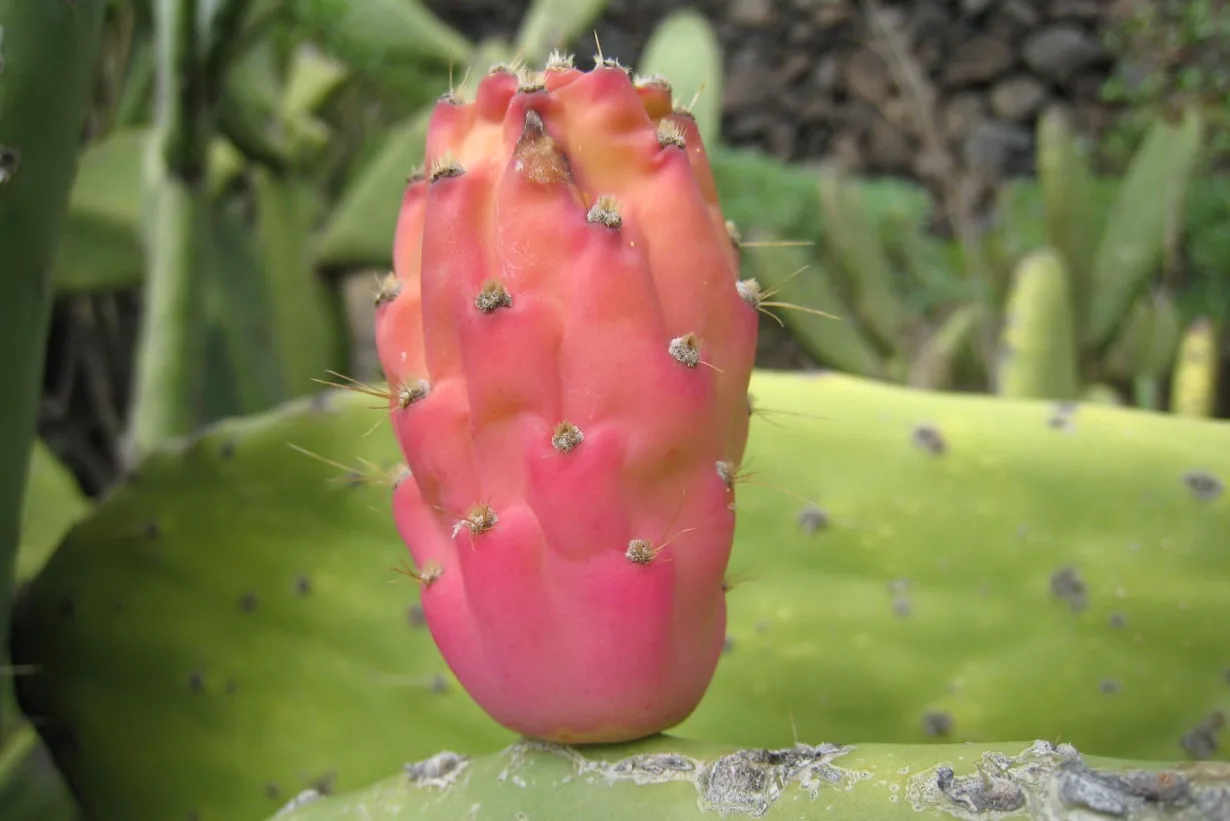
Prickly pears look like cacti as most of us know them. Their leaves, which botanists call cladodes, are oval, flat and fleshy. They flower yellowish orange from May to July. Their egg-shaped fruits are yellow to orange-red when ripe and covered with countless very fine spines. You should therefore never touch them with bare hands, because these tiny spines stick in your fingers and are hard to remove, even with tweezers and a magnifying glass. The fruits, however, are quite tasty.
The giant fennel
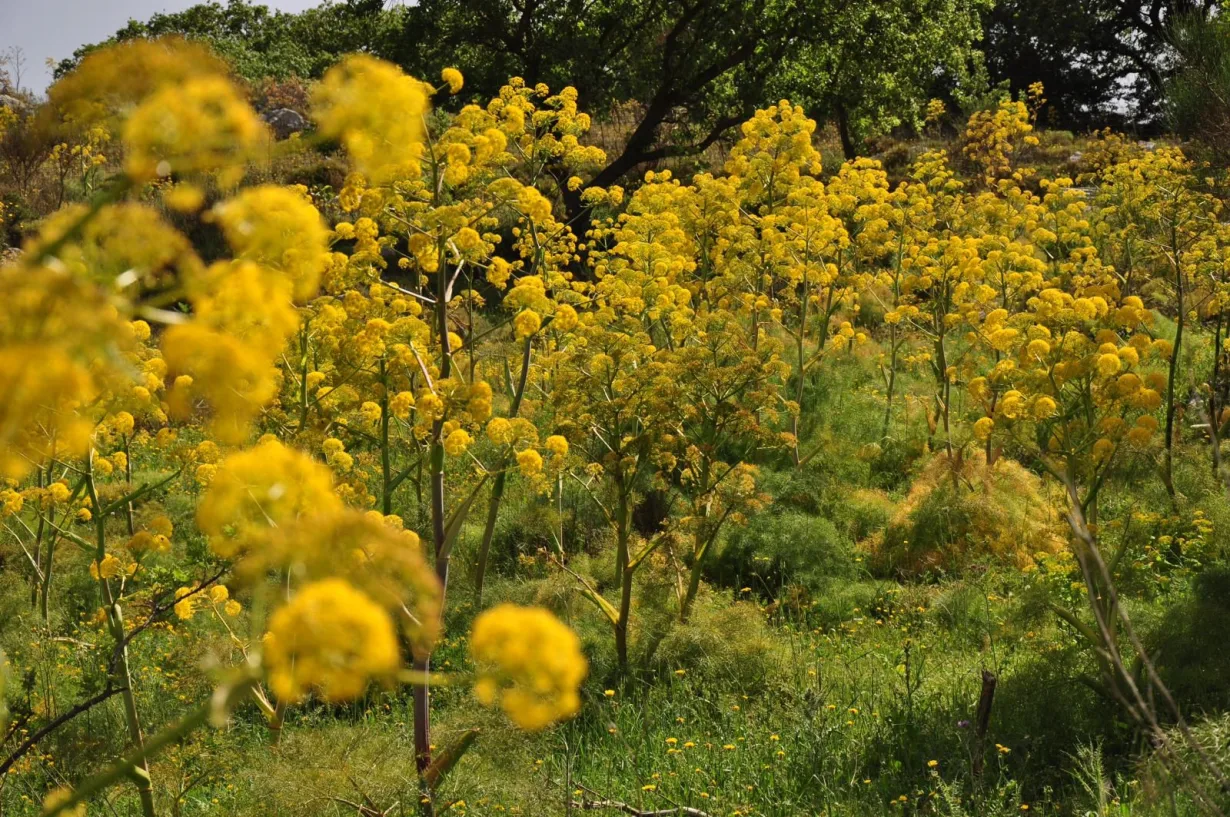
One of the most striking plants in the Greek countryside, and sometimes along the roadside, is the giant fennel (Ferula communis). Its sturdy stalks, up to 3 cm thick, grow up to 3 m tall. From spring to early summer the giant fennel forms umbrella-shaped clusters of many small yellow flowers. Once they have withered, the stalk dries out but remains standing. Inside it, a spongy pith hardens, which was of great importance to the people of the Mediterranean for thousands of years.
Once lit, the dry pith smoulders for hours and even days. Fishermen and sailors therefore used to take giant fennel stalks out to sea so that they always had fire to hand, and according to Greek myth, Prometheus brought fire to mankind in a giant fennel stalk. Please don't try this out in nature, though: in summer the risk of wildfires on Crete is very high.
The castor oil plant
The castor oil plant, also called the castor bean, grows as an ornamental plant in some gardens and in the wild along sunny roadsides. Above ground it only lives for one year, but in that time it shoots up to five metres into the sky. On Crete it flowers between August and mid-November. Not only its stems are red, but also its male flowers. Its fruits are reddish capsules covered with soft spines. If you break them open, three bean-shaped seeds with a beautiful reddish-brown marbling come to light. Never put them in your mouth or even scratch them, because the seed coats are highly poisonous.
The asphodel
The asphodel (Asphodelus aestivus or microcarpus) is a member of the lily family. The plant grows up to 1.5 m tall. Its richly branched, six-petalled flowers sit close together and are greyish white with a distinct reddish-brown central vein. Whole meadows and slopes are covered with them. For the ancient Greeks, the asphodel was the typical plant of the underworld.
The Botanical Park of Crete
Barely 60 km from Georgioupolis, above Crete's "Orange Valley" near Fournes, the Botanical Park of Crete has grown on land struck by a large forest fire in 2003. More than 150 different species of fruit trees from all over the world thrive here on 20 hectares, along with herbs and medicinal plants, flowers and flowering shrubs. Plants from three different climate zones feel at home here, among them many tropical beauties as well as Cretan ones. Signs in Greek, English and Latin tell you their names. A 2 km circular path and 1 km of side paths lead through the park, which is open daily from 9 am from the end of March to the end of November. You can read more about the park and its surroundings on our page about Agia, Meskla and Therisso.
Which plants end up in Cretan kitchens and home remedies, you can find out on our page about Cretan herbs.
You are in category:
You might also be interested in:
gorgeous
beaches romantic
old towns picturesque
places fascinating
ancient sites imposing
gorges unique
nature delightful
boat trips rewarding
excursions extraordinary
stalactite caves adventure
& thrills secluded
monasteries gourmet
restaurants culinary
products