Gorgeous beaches
The dreamlike sandy beach of Falassarna


This beach is regularly counted among the most beautiful beaches in Crete and in Europe, and in 2026 Tripadvisor users ranked it fifth in Europe. Falassarna beach is a dream destination for a day trip among sun worshippers. Actually, it might be better to say that there are several destinations waiting for you here. In fact, what is commonly known as Falassarna beach consists of five different beaches, each with its own distinctive character, from fine-grained dune beach to pebbly rocky cove. The sea can be a little rougher here, which especially pleases surfers.
The sandy beach of Falassarna
For complete seclusion and protection from the wind, head north. There, next to the archaeological site of ancient Falassarna, one pebble-covered bathing bay follows the next, all facing south, of course, for the sake of the sun. Snorkellers are at home on the southern beach with its crystal-clear water over rocky ground.
The biggest beach is right in the middle. Pachia Ammos at Falassarna is the main attraction and the reason why thousands of visitors make their way to this place every summer. Despite being so popular, this kilometre-long, sun-drenched patch of earth rarely feels crowded. Thanks to its vastness, there is simply room for everyone. And the amenities here are first class too: with a wide selection of sun loungers and parasols and plenty of beach bars and tavernas, they make sure visitors want for nothing. Don't like to lie where everyone else is? A little away from the sun lounger areas, you will of course find a spot where you can spread out your own towel free of charge.
Falassarna faces west and gets Crete's north-west winds. In other words, on windy days you will find rolling waves and ideal conditions for windsurfing. It's beautiful there even on such days, and you'll also be treated to a spectacular sunset as the day draws to a grand finale. If you still feel adventurous, you can go to one of the beach parties organised by the local bars, which only end late at night.
A day trip to Falassarna and Polirrinia in westernmost Crete
Georgioupolis, Kissamos, Falassarna, Lousakies, Polirrinia (approx. 190 km): the main destinations of this trip are two archaeological sites far from the beaten track in westernmost Crete. You will drive through landscapes that are rarely visited, you can buy unique souvenirs directly from artisans, visit the little town of Kissamos and, naturally, bathe at a top beach as well.
From Georgioupolis you can swiftly reach Kissamos on the well-made highway, which even becomes a real motorway after Chania. Afterwards, follow the main road to the west coast as far as the mountain village of Platanos, where the road down to the coastal plain of Falassarna starts.
The plain often glitters in the blazing sunlight much like a wide expanse of water: hundreds of greenhouses reflect the sun's rays. The only part without them is in the far north. That is where you are headed, because there you can bathe at the super-wide, endlessly long sandy beach, look for a quiet valley in the dunes, and relax in one of the tavernas.
Ancient Falassarna
An extensive archaeological site awaits you in the far north of the coastal plain. It is fenced off, but entry is free. Here you can learn about an ancient war harbour amid the most beautiful landscape. Small, colourful paintings prompt your imagination and show how various parts of the settlement once looked.
Falassarna enjoyed its heyday in the Hellenistic period between about 350 and 67 B.C. In the beginning it was a significant harbour for the warships of the Hellenistic rulers, later it developed into an infamous pirates' nest, which the Romans destroyed in 67 B.C. Because the coast here has risen by about 6.60 m since ancient times, the ancient port now lies high and dry. You can read more about the excavations on our page about ancient Falassarna.
Via Lousakies to Polirrinia
When you're ready, drive back uphill to the coastal road and follow it until the end of the village of Platanos. There a sign points you towards Lousakies. Follow this road for 4.6 km, until another sign guides you to Galouvas. Once you've passed through the village, the sealed road ends: for the next 1,500 m you will have to cope with a narrow dirt track through the fields, which is rather bumpy in places. Then you will arrive at the village of Polirrinia. Follow the main road to the right, and after 100 m turn left up to the acropolis of Polirrinia. You can also reach Polirrinia directly from Kissamos, on a signposted road of about 7 km.
Here you can take a short hike up the narrow paths to the ancient site, wander through the present-day village, and stop by a passionate wood carver to sample a glass of his deliciously spiced raki and take a look at his original work, which also makes a great souvenir.
Polirrinia
Polirrinia is certainly one of the least known archaeological sites in all of Crete, and yet these remains of the past lie amid an isolated, mountainous landscape of particular beauty, some of them even in the middle of a village that has stayed close to its roots and far from the beaten track.
According to several ancient authors, Polirrinia was the most important city in western Crete. There have still not been any archaeological excavations on a grand scale here, so there is most probably still plenty to discover. Your journey of discovery can start where the small road leading towards the acropolis ends. This is where the church of the 99 Holy Fathers stands. It is always closed. 31 stone blocks with ancient inscriptions have been built into its outer walls; you will easily spot them. The terrace on which the church stands is really the foundation of an ancient temple. You can clearly make out the carefully worked stonework of the temple terrace if you stand south-west of the church. Two traditional, circular threshing floors also lie in front of the western façade of the church. Just a few steps further on, you can easily recognise the outlines of cisterns and of houses carved out of the rock.
From the church, a signposted footpath through untamed nature takes you up to the hill of the acropolis, which offers a fantastic panoramic view, as well as some remains of the city wall and several cisterns. The small chapel there is a great place for a picnic.
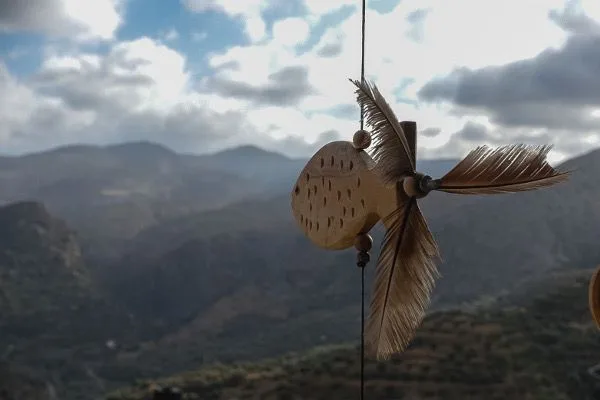
To get to the village, leave your vehicle on the access road to the acropolis beside the taverna and walk along the broad, paved path, which first takes you to the signposted carving workshop O Vrachos. Its owner, Giorgos Tsichlakis, was a cabinet maker for 12 years, but now he mostly carves small souvenirs, mobiles and wind chimes from olive wood. Every autumn he distils his own raki and pours it generously for his visitors. His speciality is a raki mixed with herbs, which tastes something like a good Bavarian monastic liqueur. It's a short walk from his workshop into the village, with its many old houses dating back to Venetian times, as well as the remains of a cistern and an aqueduct from the reign of the Roman Emperor Hadrian in the 2nd century A.D.
Back to Georgioupolis
After this second brief visit to antiquity, head back to the coast through a very peaceful landscape and take the National Road on to Georgioupolis.
You are in category:
You might also be interested in:
Experience Crete Your itinerary contains 1 experience
gorgeous
beaches romantic
old towns picturesque
places fascinating
ancient sites imposing
gorges unique
nature delightful
boat trips rewarding
excursions extraordinary
stalactite caves adventure
& thrills secluded
monasteries gourmet
restaurants culinary
products